How often should I check my baby's breathing?

As often as you feel you need to. And if you feel compelled to check your baby's breathing all the time, you're not alone. Consider your vigilance a reflection of how seriously you're taking parenthood.

How often should I check my baby's breathing?

It may help to keep in mind that babies have various stages of slumber — sometimes deep and still, sometimes active, sometimes noisy and snuffly. Your comfort level should grow with experience, but it's okay if you continue to make nightly forays into your child's bedroom, just to check on his breathing, for years to come.
Danielle Buckley-Werner remembers feeling panic-stricken every time she put her son to bed during his first months of life.
"I was sure that if I wasn't there to hear him breathe, then he couldn't take a breath," she says. "I was so tired all the time because when he slept, I would watch him. I finally collapsed on the floor of the nursery one afternoon and realized that something had to give if I was going to have the energy to be a good mom."
Buckley-Werner started taking naps with her son and using a baby monitor when she couldn't. For the first three months, she and her husband, Daniel, kept the crib in their room so they could easily respond to any coughs, cries, or breathing emergencies — which, thankfully, never arose.
"I can't tell new parents that they shouldn't worry and that constantly checking breathing is insane," says Buckley-Werner. "But depriving yourself of rest and waking your baby up all the time will exhaust everyone. For me, keeping my baby close helped me overcome my fears that he'd stop breathing."

Source: babycenter.com

Video: How to change a diaper

Find out how to change a diaper for a baby boy or girl. Get useful tips and tricks, and learn common diapering mistakes.

clip_image001[5]

Video Transcript

Narrator: Before you get your little one's diaper in a twist, it's a good idea to learn how to properly diaper your baby.

The average newborn goes through eight to ten diapers a day. For the parents of twins Jack and Madison, that's double diaper duty – and double trouble when they get it wrong.

Nurse Shari Criso: See how low this is? And that's probably why he's peeing through.

Narrator: Shari Criso – a nurse, midwife, and baby expert in New Jersey – is guiding these new parents through her tried and true diapering tips.

To start, you'll want to wash and dry your hands or clean them with a baby wipe.

Nurse: Make sure that the surface is nice and clean. Have all your supplies ready, so you're not having to walk away or reach for them.

Narrator: You'll need a clean diaper, of course, and plenty of baby wipes or something else to wipe your baby with, like moistened paper towels or a damp washcloth.

To prevent or treat diaper rash, keep diaper cream, ointment, or petroleum jelly on hand.

Nurse: You want to find a safe place where the baby's going to be safe and can’t roll off.

Narrator: Many diaper changing tables come with a safety strap, but you probably don't want to rely on the strap alone.

Keep at least one hand on your baby at all times. You never know when she may suddenly learn how to roll over or scoot off the table.

Nurse: Keep talking to your baby while you're changing their diaper. This is a great time for you to interact with your baby. Hi, sweetheart – yes, you like this? Lift the baby up and pull the clothes all the way away from the diaper.

Take your clean diaper and open it up. And you'll know which side is the back because it's the side that has the tabs on it.

Narrator: Grasp your baby by the ankles, gently lift her bottom, and slide a clean diaper under the soiled one.

Nurse: We'll take off the first diaper. I like to fold these in so they don't stick to everything. Okay? And then if the baby is soiled with a bowel movement, what you could do is use the diaper to actually wipe off the excess as you go down.

Narrator: Fold the dirty diaper in half under your baby, clean side up.

Nurse: Now we are going to take a wipe, and what we're going to do with a girl baby is always make sure that you're wiping from the front to the back. Okay, that way we avoid spreading any kind of infection to the baby. Okay? So we're going to wipe down. Turn the wipe over so you get a clean spot, wipe in the folds.

Narrator: Lift your baby's legs to clean her bottom.

Nurse: Clean anything that's residual underneath. Put that right into your dirty diaper, roll that up.

With a boy you want to make sure you're getting all around all the different areas that poop can hide in. And the other thing is try to keep it covered or you're both going to get sprayed.

For both boys and girls, it's a good idea to let the diaper area air dry before applying any ointment or cream.

Nurse: A little bit of cream on his bottom. And when you go to put the diaper back on, try to put his penis in a downward position so that when he does urinate it doesn't shoot up the top.

If your baby boy is newly circumcised, follow your pediatrician's instructions for special care you may need to take during diapering.

Nurse: So one of the most common mistakes that moms and dads make when they're changing diapers is they don't pull the diaper up high enough, okay, they have them like a low rider. We need to hike them all the way up.

So actually after the first two weeks when the belly button finally comes off, you want to come up and cover the belly button.

Narrator: Before your newborn loses his umbilical cord stump, you'll need to fold the front of the diaper back so it doesn't rub against the stump. Or you can use a diaper made for newborns that has a notch specially cut out.

Nurse: So you're gonna pull it up nice and high in the back. Now you'll be able to bring the front up over. Hold both sides nice and tight with one hand. Grab this, pull it across tightly.

Narrator: Make sure the diaper is snug, but not so tight that it pinches your baby's skin. Check the back and elastic around the legs to make sure there are no gaps.

Nurse: And then you'll have no leaks.

Narrator: Parents today have several options when it comes to diapers.

Nurse: The first type is the traditional disposable diaper – single use and then throw away. Today's cloth diapers are really different than our mothers' were. It actually opens with Velcro. Now these are completely reusable. And there's a third type of diaper, which is a hybrid. It's a combination of the first two. The outer shell is one that would be used again, and the inner part is an insert that would get tossed, so you can get the best of both worlds.

Narrator: Try out different kinds to see which is most comfortable for your baby or best suits your lifestyle, and check the manufacturer's instructions for specific tips. Once you pick a brand, you'll probably buy a supply in bulk.

After disposing of the dirty diaper in a diaper pail or disposable trash bag, dress your baby and wash your hands thoroughly.

That's it – you're done!

Source: babycenter.com

How to change a cloth diaper

These instructions show how to change a basic type of cloth diaper: an interior diaper, made of cloth, and a separate waterproof cover that goes over it. (There are many other types of cloth diapers, too. The same basic directions can be used for other cloth diapering options – just substitute your diaper of choice for what we describe here.)

How to change a cloth diaper

While there's no one right way to change a cloth diaper, here are a suggested series of steps to get you started. In time, you may modify the steps and develop your own preferred method – which you'll be able to do in a darkened room while half-asleep.

Preparation

Wash and dry your hands, or clean them with hand sanitizer or a baby wipe.

Set up a warm, clean area to change your baby. If you're not using a changing table, consider laying a blanket, towel, or changing mat on the floor or bed.

Assemble your supplies:

· Clean diaper

· Clean diaper cover, in case the one your baby's wearing got dirty

· Diaper fastener (Snappi and Boingo are popular brands) or safety pins

· Cloth wipes, baby washcloths, or disposable wipes for cleaning your baby. (Dampen the cloth or washcloth with warm water or a homemade solution of warm water and a little liquid soap.)

· Dry wipe or washcloth, to dry your baby if you won't be letting your baby air-dry

Optional items:

· Rash cream, if your baby is fighting a diaper rash. (Make sure to select a cream that works with cloth diapers, since standard rash creams and jellies are difficult to wash out of cloth diapers and may ruin them.)

· A cloth or disposable liner. Liners wick moisture away from your baby and into the diaper. Disposable liners make it easier to dispose of poop and also help protect cloth diapers from lotions and creams. Cloth liners can be used to protect diapers, too, in which case they should be washed separately from the diapers.

· An insert or booster, sometimes called a doubler, for added absorbency. (Some inserts are also topped with a stay-dry fabric.)

Safety note: If you change your baby on an elevated surface such as a changing table or bed, be sure to keep one hand on your baby at all times. Most changing tables have a strap you can use to secure your baby. Whether your baby is strapped in or not, don't leave your baby unattended for even a second. Babies of any age can squirm off the table unexpectedly.

Diaper change

1.

Lay out the clean diaper. (Some types of cloth diapers need to be folded first.)

How to change a cloth diaper

2.

Unfasten the diaper cover your baby's wearing and bring down the front part of the cover.

How to change a cloth diaper

3.

Unfasten the dirty diaper and pull down the front half. If your baby is a boy, you might want to cover his penis with a clean cloth or another diaper so he doesn't pee on either of you.

How to change a cloth diaper

4.

If there's poop in the diaper, use the front half of the diaper to wipe the bulk of it off your baby's bottom.

How to change a cloth diaper

5.

Fold the dirty diaper in half under your baby, clean side up. (This provides a layer of protection between the clean changing surface and your baby's unclean bottom.) To do this, lift your baby's bottom off the table by grasping both ankles with one hand and gently lifting upward.

How to change a cloth diaper

6.

Clean your baby's front with a wet cloth or wipe. If your baby's a girl, wipe from front to back (toward her bottom) to help keep bacteria from causing an infection.

How to change a cloth diaper

7.

If your baby pooped, grab another wipe and clean his bottom. You can either lift his legs or roll him gently to one side then the other. Be sure to clean in the creases of your baby's thighs and buttocks.

How to change a cloth diaper

8.

If you have time, let your baby's skin air dry. Otherwise pat dry with a clean cloth. If necessary, apply a rash cream that works with cloth diapers.

How to change a cloth diaper

9.

Remove the dirty diaper and, if it got soiled, the diaper cover. Set them aside.

How to change a cloth diaper

10.

Place the clean diaper underneath your baby so that the back edge is in line with your baby's waist.

How to change a cloth diaper

11.

Pull the front half up to your baby's tummy. If your child is a boy, be sure to point his penis down so he's less likely to pee over the top of the diaper.

How to change a cloth diaper

12.

For newborns, position your baby so the back of the diaper is higher than the front: You don't want the fabric to irritate the umbilical cord stump. Many newborn diapers and diaper covers have a snap- or fold-down area for the cord.

How to change a cloth diaper

13.

Make sure that the part of the diaper between your baby's legs is spread as wide as seems comfortable. Too much bunching in that area can cause chafing and discomfort.

How to change a cloth diaper

14.

Fasten the cloth diaper. Some come with built-in snaps or tabs. Prefold and flat diapers, which you fold yourself, require fasteners or pins. Be sure the diaper is snug but not so tight that it pinches.

How to change a cloth diaper

15.

Once the clean diaper is on, place the outer cover over it. (You'll either reuse the cover your baby was wearing before or, if it got dirty, replace it with a clean one.) Fasten the cover with its tabs or snaps.

How to change a cloth diaper

16.

All changed!

How to change a cloth diaper

17.

Dress your baby and put him in a safe place, like on the floor with a toy or in his crib.

How to change a cloth diaper

18.

Dump as much of the poop from the diaper and cloth wipes or washcloths into the toilet as you can. (Poop from formula or solids isn't water soluble and won't rinse away in the washing machine. Poop from an exclusively breastfed baby, on the other hand, is water soluble and doesn't require rinsing.) A diaper sprayer – similar to a kitchen sink sprayer that attaches to the toilet – is a useful tool for getting as much poop into the toilet as possible. You can also swish the diaper and cloths in a clean toilet bowl. Put the dirty diaper and wipes – and dirty cover, if there is one – in yourdiaper pail or hanging wet bag.

How to change a cloth diaper

19.

Wash your hands thoroughly or use hand sanitizer if you can't get to a sink. That's it – you're done!

How to change a cloth diaper

Cloth diapering tips

· Change diapers frequently to avoid diaper rash. It's especially important to change poopy diapers as soon as possible, since they can cause diaper rash quickly.

· Learn about the difference between regular diaper rash and yeast diaper rash, since they need to be treated differently.

· Keep distractions handy. If your baby fusses during changes, hang an engaging mobile over the changing area, put up pictures or mirrors to look at, or give your baby a small toy to play with while you take care of business.

· Stock up on clean diapers or plan to wash them often enough that you won't run out. Newborns can wet as many as 14 cloth diapers a day. It's recommended that you purchase 18 diapers for a newborn, if you want to wash daily. If you want to wash every other or every second day, you'll need two or three dozen diapers.

· If you opt to use a diaper pail to store dirty diapers, you may want to use a liner to cut down on odors and keep ammonia from the diapers from leaching into the pail. Some parents use liquid in the diaper pail because they think it reduces odors and stains, but it's generally not recommended – it can create a drowning hazard for young children and cause deterioration of the diapers and setting of stains. Your best bet for avoiding stains is to soak diapers for an hour or two before washing.

· Have fun: Diaper changes offer a chance for some special one-on-one time. Talk and sing to your baby, pointing out the different parts of your baby's body and explaining what you're doing. Once your baby is cleaned up, try a few simple songs like "Itsy Bitsy Spider" or "Head, Shoulders, Knees, and Toes." Play a bit of peekaboo or patty-cake, and share a kiss before you wrap up.

Cloth diapering on the go

When you're away from home, bring a wetbag to stash dirty diapers in until you get home.Wetbags are waterproof bags that help reduce odors.

You can bring one small bag, containing a clean diaper and a couple of wipes, for each diaper change. Each time you change your baby, simply exchange the clean items in the bag for the dirty ones.

Alternately, you can have one larger wetbag to put all the dirty diapers in. Another option is a wet/dry bag, which allows you to put clean things on the dry side and dirty things on the wet side.

For wipes, if you choose not to use disposable wipes on the go, you can bring pre-moistened cloth wipes in a small, clean wetbag. Or you can tote dry cloth wipes with a small spray bottle filled with a mild water-and-soap solution. (Simply spray the solution onto a wipe when you need one.)

If you're using diaper covers, remember to bring an extra diaper cover, too, in case the one your baby's wearing gets soiled.

Source: babycenter.com

How to change a disposable diaper

Whether you're using a conventional disposable diaper or one of the newer, more earth-friendly options, the methods for changing a dirty one are the same.

How to change a disposable diaper

That said, there's no one right way to change a diaper. Below is a suggested series of steps to get you started. In time, you may modify them and develop your own preferred method – which you'll be able to do in a darkened room while half asleep.

Preparation

Wash and dry your hands, or clean them with hand sanitizer or a baby wipe.

Set up a warm, clean area to change your baby. If you're not using a changing table, consider laying a blanket, towel, or changing mat on the floor or bed.

Grab your supplies, including a clean diaper and plenty of wipes or wet cloths. For babies with sensitive skin, you can use lukewarm water and gauze. If your baby is prone to diaper rash, keep rash cream or petroleum jelly on hand.

Safety note: If you change your baby on an elevated surface such as a changing table or bed, be sure to keep one hand on your baby at all times. Most changing tables have a strap you can use to secure your baby. Whether your baby is strapped in or not, don't leave your baby unattended for even a second. Babies at any age can squirm off the table when you least expect it.

Diaper change

1.

Open up a new clean diaper and place the back half (the half with tabs on either side) under your baby. The top of the back half should come up to your baby's waist. Now the clean diaper is ready to go – and is there to protect your changing table from getting dirty. (If your baby's dirty diaper is a big mess, you might want to lay a cloth, towel, or disposable pad under your baby instead of the clean diaper while you clean up your baby.)

How to change a disposable diaper

2.

Unfasten the tabs on the dirty diaper. To prevent them from sticking to your baby, fold them over.

How to change a disposable diaper

3.

Pull down the front half of the dirty diaper. If your baby is a boy, you might want to cover his penis with a clean cloth or another diaper so he doesn't pee on either of you.

How to change a disposable diaper

4.

If there's poop in the diaper, use the front half of the diaper to wipe the bulk of it off your baby's bottom.

How to change a disposable diaper

5.

Fold the dirty diaper in half under your baby, clean side up. (This provides a layer of protection between the clean diaper and your baby's unclean bottom.) To do this, you'll need to lift your baby's bottom off the table by grasping both ankles with one hand and gently lifting upward.

How to change a disposable diaper

6.

Clean your baby's front with a damp baby wipe, cloth, or gauze. If your baby's a girl, wipe from front to back (toward her bottom). This helps keep bacteria from causing an infection.

How to change a disposable diaper

7.

If your baby pooped, grab another wipe and clean her bottom. You can either lift her legs or roll her gently to one side then the other. Be sure to clean in the creases of your baby's thighs and buttocks, too.

How to change a disposable diaper

8.

Let your baby's skin air dry for a few moments or pat it dry with a clean cloth. To help treat or prevent diaper rash, you may want to apply rash cream or petroleum jelly. (The best defense against diaper rash is a dry bottom, achieved through regular diaper checks and changes.)

How to change a disposable diaper

9.

Remove the dirty diaper and set it aside. If you followed step one, the clean one should be underneath your baby, ready to go.

How to change a disposable diaper

10.

Pull the front half of the clean diaper up to your baby's tummy. For a boy, be sure to point the penis down so he's less likely to pee over the top of the diaper.

How to change a disposable diaper

11.

If your baby is a newborn, avoid covering the umbilical cord stumpuntil it's dried and fallen off. You can buy special disposable diapers with a notch cut out for the stump or fold down the front half of a regular diaper.

How to change a disposable diaper

12.

Make sure that the part of the diaper between your baby's legs is spread as wide as seems comfortable. Too much bunching in that area can cause chafing and discomfort.

How to change a disposable diaper

13.

Fasten the diaper at both sides with the tabs. The diaper should be snug but not so tight that it pinches. Make sure the tabs aren't sticking to your baby's skin.

How to change a disposable diaper

14.

All changed!

How to change a disposable diaper

15.

Dress your baby and put her in a safe place – like on the floor with a toy or in her crib – while you clean up the diaper changing area.

How to change a disposable diaper

16.

Dump any poop into the toilet, if possible. Fold up the dirty diaper and fasten it closed with its tabs, then put it in the trash or diaper pail. If it'sflushable or compostable, dispose of it according to the manufacturer's guidelines.

How to change a disposable diaper

17.

Wash your hands thoroughly, or use hand sanitizer if you can't get to a sink. That's it, you're done!

How to change a disposable diaper

Diapering tips

· Change diapers frequently to avoid diaper rash. It's especially important to change poopy diapers as soon as possible, since they can cause diaper rash quickly.

· Learn about the difference between regular diaper rash and yeast diaper rash, since they need to be treated differently.

· Keep distractions handy. If your baby fusses during changes, secure an engaging mobile over the changing area, hang pictures or mirrors to look at, or give your baby a small toy to play with while you take care of business.

· Stock up on diapers so you don't run out. Newborns can wet as many as eight to ten diapers a day.

· Some disposable diapers for young babies have a wetness indicator on them – a line that turns color if the diaper is wet. This isn't necessary, but it can be a convenient way to tell at a glance if it's time for a change.

· If poop keeps leaking out the top back of your baby's diaper, it may be time to go up a size. The weights noted on diaper packaging are just guidelines, and your baby may need a bigger size sooner.

· When you leave home, carry some extra plastic or biodegradable bags with you so you have somewhere to put dirty diapers if there's nowhere to dispose of them. (Get our full list of diaper bag essentials.)

· Have fun: Diaper changes offer a chance for some special one-on-one time. Talk and sing to your baby, pointing out the different parts of your baby's body and explaining what you're doing. Once your baby is cleaned up, try a few simple songs like "Itsy Bitsy Spider" or "Head, Shoulders, Knees, and Toes." Play a bit of peekaboo or patty-cake, and share a kiss before you wrap up.

Source: babycenter.com

Making Your Newborn Sleep All Through The Night!

Does your newborn sleep through the night? In the first few weeks, new born babies sleep a lot.

They will not sleep when you want them to sleep.

There are many reasons that your newborn have trouble to sleep. Sleep problems are common in newborns.

The main thing is that they don’t know the difference between day and night. The other reason of newborn sleep problem is they can’t hold enough milk in their tiny stomach and after few hours they wake up for milk.

Newborn baby sleep can be affected when they are exposed to bright light or conversational speech sounds.

clip_image001

Follow these tips for your newborn sleep:

As the newborns don’t know the difference between day and night, you should establish the surrounding environment suitable for your baby. The room should be quiet, calm, dark and unstimulating to make your baby understand that it is the time to sleep.

Newborn sleeps eight to nine hours during daytime and about seven to eight hours at nighttime. They will be ready to drink milk for every three to four hours. At nighttime, there is no need to wake your newborn for feeding unless your doctor suggests it.

But, don’t allow your newborn to sleep more than five hours continuously without feeding in the starting months.

When your newborn cries in the night, reach him or her as soon as possible. Don’t allow the baby to wake up completely and reach a miserable state. Pick your newborn, soothe the baby and feed him/her.

Watch your newborn sleep pattern and if the baby is sleeping consistently, and waking up suddenly and crying, then you should notice that there might be some problem.

Put your newborn to sleep in the crib on his back or side when he begins to doze during daytime. When you put your baby always in the crib when he is sleepy, he learns that crib is the place for sleep.

It is natural that newborn sleep while sucking at the breast, bottle or pacifier. When your baby sleeps in this way, he learns to sleep while sucking and he cannot sleep I any other way. If you want your newborn to sleep without you, you can allow sometimes your newborn suck until he is sleepy.

Remove the breast or pacifier when he is not totally asleep. Sometimes, your baby resists when you remove the breast or pacifier. You can give him back and again remove it. In this way, they will learn to sleep without sucking.

Watch for tired signals in your baby. When you notice tired signals in your baby, put him down to sleep.

Your baby cannot understand his own sleep signs and if he is not put to sleep, it can lead to sleep depression. You have to carefully read your baby’s signs and put your newborn to sleep immediately.

If your newborn is still not sleeping, then consult your pediatrician so that he can diagnose if there are any other conditions that are making your newborn sleep disturbed.

Source:

Newborn Sleep: Week 1

Right now, sleep is a luxury that was once taken for granted. Just to have five hours of uninterrupted rest probably sounds as close to bliss as you can imagine, yet it seems as though that will never happen – ever again.

clip_image001Don’t worry, it will, but we have to admit that most babies still wake to feed every two to three hours (sometimes stretching it to four hours at night if you have an exceptionally considerate baby) for the first six to eight weeks – give or take. And then it will most likely be another few months before the baby is sleeping through the night. We know it sounds impossible to get through this when you’re in week one, but before you know it, you’ll be looking back at this fuzzy, sleep deprived time and hardly remember it. (Probably because you’ve been half asleep this whole time.) Here are more tips worth knowing about your baby’s current sleep pattern:

  • There’s not much parents have to do to encourage or schedule their baby’s sleep patterns during the first week. As you’ve probably noticed, they’ll sleep anywhere, anytime – whether it’s in the middle of a feeding or just as the family comes over to visit.
  • The baby will sleep a whopping 14 to 18 hours a day right now, which seems as though you’d have plenty of time to sleep yourself, right? However, their irregular short naps (one or two hours at a time) don’t leave nearly enough time for you to feel rejuvenated.
  • It’s assumed that babies need these short naps in rapid eye movement (REM) sleep to aid in their development.
  • Don’t let your baby go three hours without nursing or four hours without drinking formula at this stage.
  • Put your baby to sleep on his or her back to reduce the risk of Sudden Infant Death Syndrome (SIDS).

Sometimes, depending on the time of day your baby entered the world, his or her internal clock might be off, thinking day is night and night is day. Even though the baby will be sleeping around the clock at almost even intervals, your baby might take his four-hour sleeping stretch in the middle of the afternoon and be more alert and awake at night. Don’t worry – the problem will fix itself before you know it, mostly because our biological clocks are automatically programmed to be awake when it’s light and sleepy when it’s dark. However, starting a bedtime routine – like shower, baby massage, story, bed – will help indicate that it’s time to get sleepy.

Where Should Baby Sleep?

You have quite a few options when it comes to you and your baby’s sleeping arrangements – some more recommended than others. We think you should have an open mind, ultimately choosing the option that allows the most people to get the most sleep.

  • In a bassinet or cradle, in your room. This is the most popular option with many experts, citing the in-room convenience of around-the-clock feedings, but with the safety of putting the newborn in his or her own space. And with all sleeping option, experts agree that babies should sleep on their back to reduce the risk of SIDS.
  • Co-sleeping. The more traditional, attachment-parenting method, co-sleeping is when the newborn is brought to sleep in your own bed. While this is most convenient for those breastfeeding, the use of pillows, comforters and soft mattresses are hot spots for SIDS controversy. There have also been rare cases of adults rolling over and suffocating their baby. Despite these risks, for people all around the world, it’s still a very popular and comforting way to sleep.
  • Co-sleeper bassinet. A hybrid between the former two options, a co-sleeper bassinet allows the baby to be close to Mommy while still having a separate, safe sleeping space.
  • A crib in the nursery. Some parents decide to go for the gusto and just place the baby in his or her own room from the get-go. You didn’t spend all that time decorating for the room to remain empty, now did you?

Source: babble.com

Newborn Bath Tips and Tricks

Baths can be fun for Mom, Dad and baby, but there are also times when things won’t go as smoothly as you would hope. Here are a few tricks to help keep bath-time on the fun track.

clip_image001

  • Make sure the room (bathroom, kitchen, etc) where the baby will be bathed is warm and draft-free and you can be comfortable.
  • Keep the baby diapered (especially boys who are known to shoot straight up at inopportune moments) until you’re ready to wash that area, or place baby in the tub.
  • Avoid giving your baby a bath immediately after he’s eaten. Newborns are more likely to spit up post-meal, and you don’t want him to need a second bath before he’s even out of the first.
  • Avoid giving your child bubble baths. Studies show they can increase the incidence of bladder inflammation.
  • Think about where you place the baby bath, especially if you have a bad back. Find a spot that is stable and at a comfortable height.

Newborn Bathing Safety

To keep your newborn safe, place everything you could possibly need within reach before you begin so one hand can stay on baby at all times. This means keeping the soap, washcloth, towel, diaper, and a change of clothes nearby. When the bath is done, wrap her quickly in a towel so she doesn’t lose too much body heat.

clip_image001

A few safety rules to remember:

  • Never leave your newborn alone in the tub.
  • Get all of your supplies (soaps, towels, cotton balls, washcloths, etc) together before you undress your newborn. If you forget something, wrap baby in a towel and bring him along for the ride.
  • Never leave baby in the care of another child, even for a moment.
  • Empty the tub completely right after the bath. A baby can drown in as little as one inch of water.
  • Use a plastic or sponge spout cover so baby doesn’t hit her head on the faucet.
  • Place a nonskid mat on the tub floor to prevent baby from slipping.
  • Learn infant CPR.
  • Keep bathroom doors closed and toilet seats down.
  • Keep your water heater at 120° F so baby won’t get burned if the faucet accidentally gets turned on.
  • Don’t put your little one into the tub when the water is still running. There is always the possibility that the water could get too deep or the temperature could change.

How to Bathing Your Newborn

Bath-time Essentials

Bathing your newborn can seem incredibly daunting. They look so small and vulnerable naked, and can be so slippery and seemingly impossible to get into the tub. Before placing your newborn in the tub, you’ll want to make sure everything is ready for washing, playing, and drying.

You’ll need:

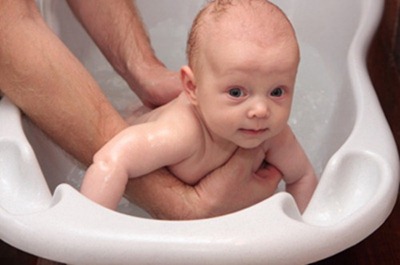
· A baby bath tub with a sling or mat to prevent the newborn from being immersed in water (not necessary for sponge bathing, but useful). There are infant tubs which support little heads and necks (like the Washpod, which purportedly mimics the womb experience) or bath positioners you can use in your tub. Before your baby’s umbilical cord stump falls off, you won’t be submerging her or him in water, so you’ll want supplies for a sponge bath. Using any plastic container full of warm water or putting a small amount of water in your infant tub should be enough.
clip_image001

· A baby bath towel washed in appropriate baby detergent. Hooded towels help you keep your baby’s head warm when coming out of the bath – and they are some of the cutest things you’ve ever seen.

· Sterile cotton balls to clean his or her eyes. Cotton balls and Q-tips are also convenient for cleaning behind ears, under arms or anywhere that needs closer attention or is still covered in vernix, the layer of cheese-like coating found on baby’s skin at birth.

· At least two soft washcloths – one for soaping and one for rinsing. It’s not necessary to buy washcloths specifically for baby (though they are typically smaller in size, cuter, and can potentially match your towels or baby d’cor).

· Fresh diapers and ointment for diaper rash and/or circumcision if necessary.

· Rubbing alcohol and cotton swabs if needed for umbilical cord.

· Access to warm water or a bucket filled with warm water.

· Clean clothes

Useful Accessories

· Gentle soap and/or shampoo. At the very beginning, simply wash your baby with warm water. When the weather is very hot or humid or when baby’s had a bad spit-up or bowel movement, you may decide that a gentle baby soap would be best. If you do use soap, use it toward the end of the bath, so baby doesn’t wade too long in soapy water. It can be very drying to your newborn’s delicate skin.

· Brush and comb. When your newborn has more hair, you might like a brush or brush and comb set.

· Baby skin care. Beyond a gentle soap, you don’t need much, but many parents use sweet smelling lotions, cleansing cloths, powders or other goodies. Just make sureto always check for any skin reactions. Your newborn’s delicate skin can respond differently than adult skin to fragrances.

· Additional items: You may want a few more items to make baths easier or more fun.

o A thermometer to make sure bathwater isn’t too hot.

o Bath toys

o A spout cover to protect baby’s head

o Tub treads to keep a tub in place on the bathtub surface

o A container for bath toys.

How Much Water

Until the umbilical cord stump has fallen off, only sponge-bathe your newborn. Once it’s fallen off and your newborn is ready for the tiny tub, you still won’t be fully submerging your baby. For newborns you need only fill the baby tub with a couple of inches of lukewarm water.

Temperatures

Babies don’t like baths as hot as adults do, so testing the water is very important.

· Make the water warm but not hot. A lukewarm tub is perfect for your newborn, anywhere between 90°F and 100°F.

· Your hands are tougher than your newborn’s skin and therefore won’t feel heat like a baby’s bum will.

· Test the tub by dipping your elbow into the water; it’s more sensitive than your hands.

· Mix the water around with your hands or a cup to ensure there are no scalding spots.

· Intermittently (and carefully) pour small cups of water over baby to keep him from getting cold.

How Often and When

For the first couple of weeks, sponge-bathe your new baby until the umbilical cord stump has fallen off and the circumcision, if one was had, has healed. Newborns only need to be cleaned three or four times a week, but a nighttime bath can be an excellent bedtime ritual.

Holding and Positions

Getting the positions just right can take some time. It’s very important to always keep at least one hand on your newborn as they can be slippery and wiggly in bath water.

· After undressing your baby, place him very gently in the tub feet-first, always making sure you keep one hand supporting his head, neck and back.

· Some baby tubs come with built-in head and neck supports, but still make sure you keep a hand on your baby.

· Wash your baby with your free hand.

· Be careful lifting your baby from the bath. Again, make sure to support the head and neck with one hand and hold their tiny tush and thigh with the other. This is often referred to as the “safety hold.”

Washing

· Start with the face. Use one sterile cotton ball for each eye, gently wiping from the inner eye outward. For the rest of the face, wash using just water.

· Then move to the chest and neck. Continue to use only water unless the baby is particularly dirty for some reason. Do the same for the arms, legs and back. Make sure you clean in all of those adorable folds.

· Lastly, wash the baby’s genitals. Follow the care for circumcision instructions for boys, but for girls, wash front to back with water. You might notice a normal vaginal discharge.

· To wash the hair, wrap your baby in a dry towel and hold him in a football hold over a sink. Use a cup to pour warm water over the scalp, and then wash the hair with just water or with a small amount of shampoo.

· Hands and feet will need a small dab of baby soap, but make sure to rinse thoroughly as they’ll most likely be in your baby’s mouth in no time.

Bathing Rituals

Bath time is a perfect time to bond with your newborn. By forming rituals with your children, bath-time can become something you all look forward to.

· Start with a toy, maybe giving a favorite ducky a name or making a puppet washcloth talk.

· Schedule a bath time and be consistent. Some parents prefer morning baths as they can be invigorating for baby, but most parents seem to agree that evening is the best time, as baths can be quite calming and help give baby a good night’s rest. But there is no wrong time of day, so find the time that works for you.

· Making your own rituals will happen naturally. Whether it’s singing a certain song or climbing in too, bath time can be fun. Enjoy it!

Post-Bath Care

Baby’s post-bath routine can take just as long as the actual bath, but it’s important not to miss anything, especially if baby’s next stop is bed.

· Dry your baby well and apply any needed cream for diaper rash or healing ointment for circumcision before diapering, clothing and swaddling.

· Find clothes with snaps or zipper closures and wide openings for the neck. Now is not the time to be fumbling with buttons. Also, onesies with built-in mittens are great to protect your baby from her surprisingly sharp fingernails.

· Take the opportunity to sing and talk to your little one, both for distraction and bonding. Explain what color the shirt and pants are, count how many snaps you’re fastening, and label each body part as you kiss them.

· Instead of trying to shimmy sleeves and pants over uncooperative limbs, try reaching into the openings and pulling his or her extremities through.

· Don’t overbundle babies at night, as instinctive as that seems. Believe it or not, babies are comfortable in 61°F to 67°F. Dress your newborn in light pajamas and a sleeper or swaddling blanket. According to the American Academy of Pediatrics, overheating increases a baby’s risk of SIDS.

HOW TO SOOTHE A CRYING NEWBORN

As you settle into life with your new baby, you quickly learn that your baby cries often. He relies on crying to communicate needs and wants. He cries when he is cold, hot, wet, hungry, hurt, or for no reason at all. According to the website Kids Health, you should console your newborn when he cries. You cannot spoil your infant, and consoling him shows him that you respond to his needs. Even though crying is normal, though, attending to a fussy baby can be exhausting. There are some techniques you can use to comfort your newborn--and maintain your sanity.

clip_image001

Step 1

Swaddle your child. Before she was born, the confined space restricted your child's movement. A good way to mimic the womb and calm your crying child is through swaddling, according to the Dr. Melanie Bee website. Use a large baby blanket and fold one corner down, placing your child on the blanket with her head at the top of the fold. Wrap one side of the blanket firmly over your child with your child's arms at her chest, fold the bottom of the blanket up, and close the last side snugly over the top of your child. Your baby's arms should be close to her chest, and the blanket should be snug to restrict flailing limbs.

Step 2

Rock your baby. According to the Mayo Clinic, rocking or taking a walk with your baby can ease crying. Your baby might be crying because he wants to move, and since he cannot move on his own, he relies on you to move for him. If rocking does not work, try a short walk with a stroller or a car ride.

Step 3

Offer your baby something to suck on. Sucking is a natural reflex that often soothes an upset baby. According to the American Academy of Pediatrics, offering your fussy child something to suck on is one of the best ways to soothe your child. You can offer a pacifier or guide her hand toward her mouth so she can suck on her skin or your clean knuckle. If your child sucks vigorously but does not seem satisfied with only sucking, she could be hungry.

Step 4

Provide white noise or a shushing sound. Your new baby can become overstimulated rather easily. If you suspect your child is crying in response to too much noise or activity, providing white noise--such as a recording of the ocean or the monotonous noise of a fan or vacuum--might help calm him, according to the Mayo Clinic. Another possibility is to making a gentle and repetitive shushing noise while rubbing your child's back, rocking him or gently bouncing him in your arms.

Source: LiveStrong.com

3 quick ways to soothe your newborn

It's hard and frustrating sometimes taking care of a newborn baby. You're overwhelmed and there's always something that needs to be done. Wash his bottles, change her diaper or throwing away those already dirty diapers. On top of all that you and/or your partner are probably sleep deprived. So when that bundle of precious joy starts to scream and holler and the normal checks (check if he's hungry, see if she's wet, is it too warm or too cold for her?) aren't soothing and comforting her, here are a few ways that may help calm your infant:

3 quick ways to soothe your newborn


Shushing:  Shushing may be rude in polite society but to an infant the noise actually calms her. The trick is to shush louder than the baby's crying so that it overwhelms her and she soothes herself. Try shushing and bouncing her at the same time, soft bouncing and loud shushing can prove to be a helpful combination to quiet your little one.
Swaddling: This is a technique I learned in the hospital the second day after delivery. My newborn was screaming bloody murder and I called one of the nurses in to help. She began wrapping up my little one like a burrito and although she fussed for a few moments she began to fall asleep more peacefully. This was the only night in the hospital where she slept so peacefully and consistently without being in my arms. The swaddling acts as a protectant comfort holding her arms and legs in place so that the fussiness she usually exhibits is cut off and all she can focus on is sleeping. The technique is simple.
You take a square or rectangular blanket (square works better because it folds evenly), fold one of the corners down so that the blanket is at a point at the bottom and the creased fold is at the top and her head is placed above the creased fold as you lie her down on it.
You softly pin down her right arm (can start with the left or right) and fold the right corner over her arm/body, then tuck the corner under her left side (you can gently roll her to make sure the tuck is tightly over her).
Tuck the bottom of the blanket, which should be at a point, into the right side of the fold. Then proceed to do the same thing with the left side corner being folded and tucked under her right side.
She should be comfortably situated in a tight burrito, if you notice any discomfort, tryagain. It takes time to get it right. (Will post photos of finished swaddling :D)

Sucking: Babies have the infinite need to suck. It's one of their first natural instincts. My newborn sucked at everything. My neck when I burped her, my arm when I coddled her and of course the nipple (bottle or your own). Allowing your baby to suck will of course soothe him because it's something he does every few hours when he feeds. There's a huge debate over pacifiers being used by newborns but I opted for the use because she seemed so determined. I usually put it in her mouth when I change her diaper, put her down for a nap when she's only in her REM (Rapid Eye Movement) sleep just to settle her down. You can also use the nipple from a bottle if you have to step away for a second to grab a diaper or bottle. Or just letting him suck when he feels the need, this helps him reach his own level of comfort and relaxation.


I hope one of these works for you! They've all proven helpful to me in the frenzy of beinga new mom.

Newborn Baby Skin Care Tips For New Parents

Newborn babies have skin that has just been exposed to a new environment outside of the womb. Newborn baby skin care is essential for the baby to be kept healthy and safe. There are a lot of newborn baby skin care tips which may not seem to make sense but these may also have a relevance to the child's well being and future.

clip_image001

Keeping Baby's Skin Clean


Babies are usually very clean for the first few months. This is because they do not consume any solid foods as of yet and may just be drinking breast milk (the best for newborns!) or formula. Babies usually get dirty only when they urinate or move their bowels. These activities usually happen several times a day and newborn baby skin care tips for these occurrences focus on cleaning that particular are.


Cleaning methods for newborn baby boys and girls differ especially when it comes to cleaning the male and female genitalia. Newborn baby skin care tips advise parents that girls should be properly but gently cleaned because any dirt left in the genitals may cause an infection. Other newborn baby skin care advices are to keep the cleaning materials as natural as possible. Cotton dipped in water may be used for cleaning the baby's bottom or genitals. Natural skin care means that the baby is safe from harsh ingredients which may clean effectively but may also trigger skin rashes or allergies.


For about three to five weeks, the newborn baby just wiped clean and not immersed in a tubful of water. Newborn baby skin care in this stage states that two small bath cloths are needed; one with very mild soap and the other dipped occasionally in water. Water should be warm enough to be comfortable for the newborn but not enough to scald him or her. Many newborn baby skin care suggestions also suggest that the parent actually hold the baby while nothing assisted by another person. This newborn baby skin care tip ensures that the parent is always holding the baby ad the chances of submersion in water or water getting to the nose or mouth is nil. Other newborn baby skin care suggestions are to wash any clothes that the baby may use before wearing with a mild detergent, to use a mild fabric softener to lessen the possibility of rashes due to stiff clothing and to make sure that the tags are cut with scissors instead of pulled out because pulling tags out may leave behind some plastic which can scratch the baby's sensitive skin.   

New Moms Newborn Basic Baby Care Tips

Being a mother of two kids, one boy and one girl, I was faced with a lot of challenges in taking care of my newborn babies. This is indeed true particularly with my first child. More than ever, for first time moms I would like to share with you my basic baby care tips which I also learned from different mothers who were around me and supported me on my first newborn baby.


1. Breast milk is still best for babies. This is the rule of thumb. This will not only benefit your baby but you as well. If in case you don’t really have milk for your baby then use milk formula of best quality. For me, this is also investment for your child so if you can afford it then go.


If you are to use milk formula, make sure that you sterilize the bottle, nipple, etc. Gone are the days that you still need to heat a bottle of formula using a hot water and check the temperature frequently by shaking a few drops on your wrist. These days you can now use distilled water. Believe me it saves time and ease the preparation of milk for your baby.

clip_image001


While feeding milk make sure that excess milk or spills should be cleaned immediately. Wipe it with towel or baby wipes. This could also cause some irritation to your baby’s skin and of course will also make the baby smells unpleasant after a while.


Don’t forget to routinely burp your baby between breasts or halfway through the bottle. And have your baby drink some distilled water around 1 to 2 oz between feeding 2 or 3 times a day.


2. Infant massage every morning. As early as first few days of your child, massage should be given on a daily basis.


You massage the head with your two hands as if you want to make a snow of ball. The objective? To really mold your baby’s head with a good shape so that your child will not blame you for having a flattened head =)


Never, never, never forget as well to massage your baby’s legs. Again why? You don’t want again to be blamed by your child for not doing so. It is a must so that your child’s legs will not be bow-legged afterwards. How do we do this? Hold your baby’s legs straight and close to each other. Then, with both hands start massaging your child’s thigh down to his knees then to his legs massaging from the outside to the inside.


Your touch should not be too light or too hard. If your baby is not enjoying it then you should stop and try again next time. For a more detailed baby massage, try to buy a video, book or take a class with a massage therapist who knows about it.


You can also apply some simple exercises and stretching to your lovable baby. As you are doing these massage and exercises, try to put some laughter to your baby’s face. This is also the time to bond so talk to your child from time to time.


3. Make sure to regularly change your baby’s diaper. Be aggressive in doing so to prevent diaper rash. You should also put petroleum jelly or cream every diaper change.


4. If the baby’s cord is still on, daily sponging with lukewarm water is enough. Tub baths thereafter when the cord has fallen off.


Applying a little baby oil at his head, back, chest, stomach and feet prior to tub baths will not do harm. A bath of two to three times a week in the precrawling months is still sufficient as long as ample spot cleaning is made during diaper changes and after feedings.


5. You should clean your baby's umbilical cord with 70% ethyl alcohol 2 times a day or every diaper change. Never let water pass or enter the umbilical cord.


6. Wipe your baby’s outer ears with a cotton balls or wash cloth but don’t try to clean the ear canal itself. The ear wax will come out unsurprisingly since the ear is naturally self-cleaning. But if it seems accumulating, then ask the doctor about it.


7. Like ears, the nose is also self-cleaning and needs no special care. Just wipe the outside preferably with wet wipes or wash cloth. Don’t use cotton swabs, tissue or even your fingernails.


8. At birth, infant’s nails are typically overgrown. Hence, trimming them is necessary to prevent them from scratching their own face. Best time to cut your baby’s nails is when he is sleeping.


If the nails are neither long nor short, it is still better to put on mittens on your baby’s little hands just to be safe.


9. As soon as the baby can see things though not yet clear, they begin to focus their eyes on objects. Sometimes, this causes them to appear as crossed eyes where just one eye focus on what he is looking at while the other just seems aimed anywhere. These eye movements mean he is still learning to use his eyes. But still it would be better to just close his eyes and restart his focus on objects.


10. While sleeping, make sure that your baby’s head position is changed regularly. For example, if his head is on the right side for an hour then try to have his head on the left side after and so on. It would also be better if his pillow is comfortable enough for his head to move around. This is to prevent from having a baby’s head with flat side.


11. Once a day or after feeding if necessary, make sure to clean your baby’s mouth with a clean wet washcloth or an infant brush where you put your finger in it. This could prevent mouth and tongue infection brought about by milk leftovers.


12. When dressing your baby, use clothing with an easy-on and easy-off feature as much as possible. This could be wide neck openings or necks with snap closings. Fairly loose sleeves and a minimum fastening should be necessary.


These are just basic tips for new moms out there. If there are things that you are in doubt about your baby’s condition that needs immediate attention, don’t hesitate to immediately call your baby’s pediatrician. They are your partners as well in the development and well-being of your baby.

How to Put Clothing on a Newborn

The stress of having your baby might be behind you, but now you're faced with a new dilemma: putting clothes on your living sack-o-potatoes. Dressing a newborn can be tricky: Many newborns have floppy arms, an oversized head and curled-up legs. Plus, they seem so fragile that you don't want to move them around too much. Dressing your newborn is another thing that comes with being a new parent, and, like other lessons you will encounter, it does get easier the more you do it.

clip_image001


Instructions

  1. Onesies and Shirts

    • 1

      Purchase clothes that have wide openings at the neck and that are easy to snap or zip up. Pick newborn or preemie sizes (depending on the size of your baby) and look for clothes with "easy-on, easy-off" features, according to "What to Expect: The First Year."

    • 2

      Lay your child on a flat surface such as the floor or the baby's changing table.

    • 3

      Stretch the neck opening of the outfit with your hands. Pull firmly, but avoid ripping the fabric. Scrunch up the outfit (typically a onesie) around the neck opening.

    • 4

      Gently cup the baby's head and slide the baby's head through the neck opening. Mind the ears and the nose and guide the clothes on rather than tug the clothes on.

    • 5

      Slide the garment over the baby's shoulders and guide the baby's arms into the arm holes one at a time. Once both arms are in the proper holes, slide the rest of the garment down the baby's body to cover the torso.

    • 6

      Button the snaps or zip the zipper at the crotch area.

    Bodysuits and Pajamas

    • 7

      Lay your baby on a flat surface such as the floor or the baby's changing table.

    • 8

      Unzip or unbutton the body suit or pajamas and separate the arms and the legs. Gently lift your baby and place the back of your baby into the torso region of the body suit.

    • 9

      Take the right leg of the bodysuit and slide it over your baby's right leg. Repeat with the left leg.

    • 10

      Gently turn your baby onto his side and slide in the baby's arm. Repeat with the other arm.

    • 11

      Carefully button the snaps that line the front or back of the garment, or carefully zipper the garment up from the bottom to the top.

  2. Source:: Ehow